Stop looking at the child as the source of the dysfunction. We often walk into a room thinking the kid is the one who is broken, defiant, or just won’t listen, but that’s a fundamental misunderstanding of how families actually work. The child is rarely the problem; they are usually just a symptom of a system that has lost its rhythm.
When a teenager starts acting out, the instinct is to fix the teenager. We try to discipline the behavior or medicate the mood, but these are just superficial patches. If you only treat the child, you’re essentially trying to fix a leaky pipe by mopping the floor instead of turning off the faucet.
Families work like interconnected webs. When you pull one string, every other string vibrates. A child’s “bad” behavior is often a messy, desperate attempt to rebalance a family system that has become stuck, tense, or imbalanced in some unspoken way.
Viewing a child in isolation ignores the world they live in. It’s like blaming a plant for wilting when the soil is toxic and there’s not enough light. If we want real change, we have to stop looking at the individual and start looking at the patterns of interaction that keep the whole house in a state of friction.
Why the Individual Focus Fails
Traditional clinical approaches often focus on the “identified patient.” This is the person, usually the youngest or the most vocal, who carries the label of being the problem. This approach puts a massive, unfair burden on the child. They become the lightning rod for every tension in the household.
When a therapist sits down with a child alone, they might uncover a lot. However, they often miss the subtle, silent ways the parents communicate or the unspoken rules that govern the dinner table. A child’s behavior is often a mirror. If parents are dealing with high levels of unspoken resentment, the child might become the person who “makes the noise” to release that tension.
We see this in school settings, too. A student gets labeled as “difficult” or “disruptive,” but when we look closer, that disruption often happens during specific transitions or in response to shifts at home. The child isn’t the driver; they are just reacting to the road conditions.
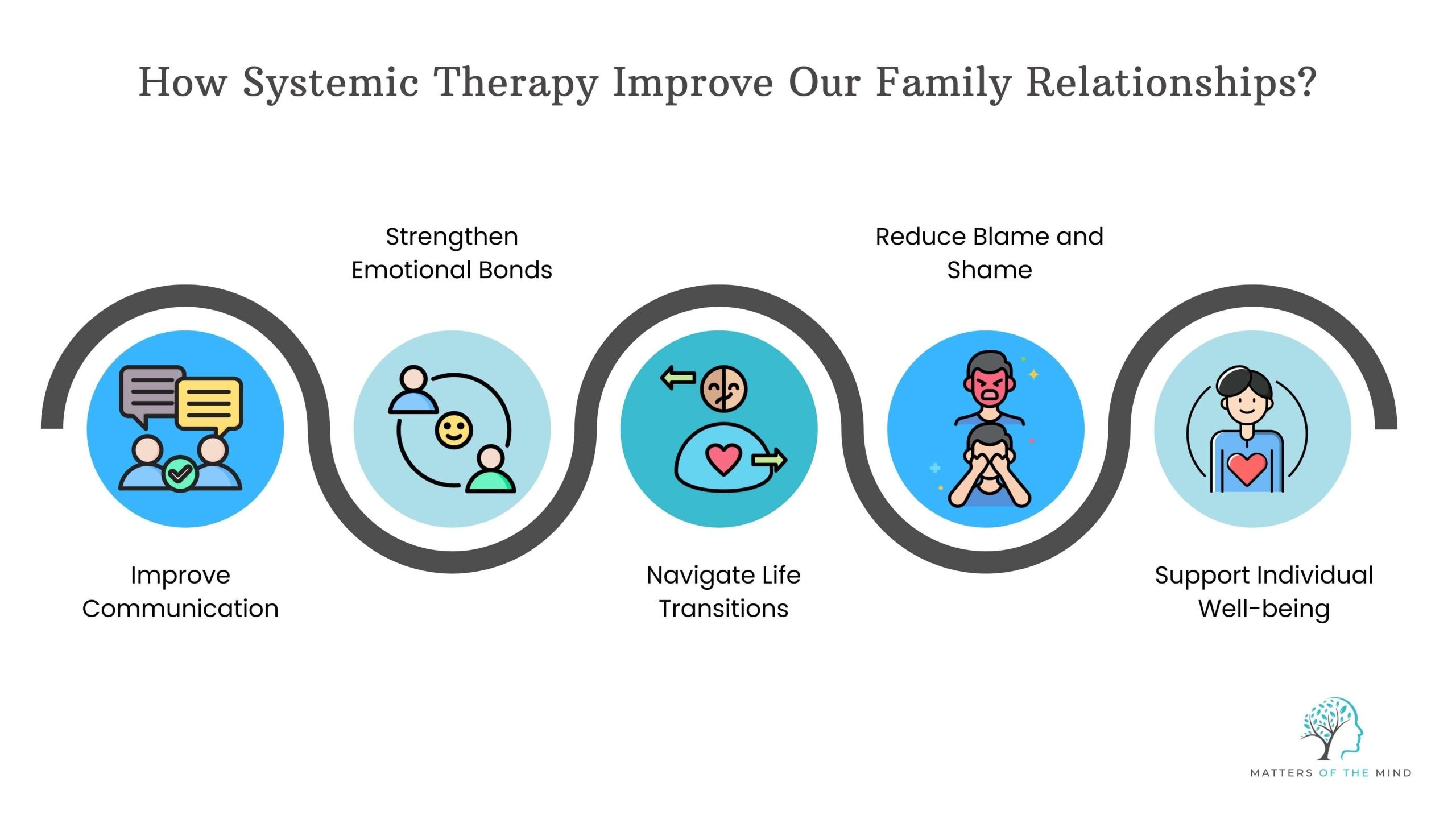
If you want to actually shift the way a family breathes, you have to address the entire ecosystem. This is why Systemic Therapy and Parent Counseling focus on the relationships between people rather than just the internal mechanics of a single person. It changes the conversation from “what is wrong with you?” to “what is happening between us?”
Consider these common shifts in perspective:
- Instead of “he is aggressive,” we look at “how does the family respond to his anger?”
- Instead of “she is withdrawn,” we look at “what role does being quiet play in the family hierarchy?”
- Instead of “they are uncooperative,” we look at “how do the parents manage conflict when the child is present?”
This doesn’t mean the child isn’t suffering. They often suffer the most because they lack the words to express what they feel. They use actions because words aren’t enough to shift the heavy, invisible weight of the family’s collective mood.
Mapping the Invisible Rules
Every family has unwritten rules. These aren’t things written on a fridge; they are the “rules of engagement” that everyone follows without thinking. They dictate who is allowed to be angry, who must stay the caregiver, and who is allowed to fail.
Some rules are healthy, like “we don’t yell at each other.” But more often, they are restrictive or even harmful. There might be a rule that says, “we don’t talk about sadness in this house,” or “the eldest sibling must always be the perfect one.” These rules create a rigid structure that leaves no room for the messy reality of being human.
When a child breaks one of these rules, they’re essentially trying to change the system. If the rule is “everyone must be happy all the time,” a child who expresses sadness is actually a rebel. They are attempting to introduce a truth that the rest of the system is working hard to ignore. This makes the child “troublesome” to parents, but it is actually an act of honesty.
Does the family system reward certain behaviors while punishing others, even if those behaviors are actually healthy? This is a hard question to face. We might find that we have unconsciously trained our children to be silent, or to be loud, or to be the “peacekeeper” just to keep our own lives manageable.
Parent counseling helps uncover these dynamics. It isn’t about blaming parents for being “bad” at their jobs. It’s about showing them that they are part of a dance they might not even realize they are performing. Once you see the dance, you can choose to change the steps.
| The Old Way | The Systemic Way |
| Focus on the “problem child.” | Focus on the relationship patterns. |
| Fixing symptoms (behavior). | Addressing the underlying system. |
| Blaming individuals. | Analyzing interactions. |
| Linear cause-and-effect. | Circular, interconnected feedback. |
The Burden of the Peacekeeper
One of the most common roles in troubled families is the “hero” or the “peacekeeper.” This is often a child who is exceptionally well-behaved, high-achieving, or perhaps overly helpful. On the surface, this child seems to be the easiest to raise, but underneath, they’re carrying an immense psychological load.
This child has learned that their value is tied to keeping the family’s emotional temperature stable. If parents are arguing, the peacekeeper tries to be extra helpful to distract them. If there is a crisis, the peacekeeper tries to be the “easy” child so the parents don’t have to worry about them, too. It’s a heavy weight for a ten-year-old to carry.
The danger is that this child isn’t actually developing their own identity. They’re developing a “performance” designed to manage the emotions of the adults around them. As they hit adolescence, this often leads to a sudden, explosive rebellion or a complete collapse into anxiety or depression. The performance becomes unsustainable.
Parent counseling addresses this by helping parents recognize when they are inadvertently leaning on a child for emotional support. It might involve a parent saying to a child, “I am the adult, and I will handle my stress; you don’t need to worry about my mood.” It sounds simple, but for a family in crisis, it is a radical act of restructuring.
When we stop requiring our children to manage our emotions, we give them the freedom to actually have their own. We allow them to be messy, angry, and imperfect without the fear that their emotions will cause the entire family structure to crumble. This is the core of healthy systemic growth.
Reframing the Narrative of Conflict
Conflict is often viewed as a sign of failure. We think that if we were better parents or if our children were more respectful, we wouldn’t be fighting. This view turns every argument into a judgment on our character. It makes conflict something to be avoided at all costs, which is actually the most dangerous thing you can do.
In systemic work, conflict is seen as information. It’s a signal that a boundary is being pushed or that a need isn’t being met. Instead of seeing an argument as a “fight,” we try to see it as a “communication error.” When a child slams a door, they aren’t just being rude; they’re signaling that they feel unheard, crowded, or powerless.
The goal of counseling isn’t to eliminate conflict, but to change the *way* the family conflicts. There is a massive difference between a family that fights destructively, using insults and silence, and a family that fights constructively, using “I” statements, setting boundaries, and staying present in the tension.
Constructive conflict allows the system to evolve. It allows for the negotiation of new rules. If a teenager wants more autonomy, they must negotiate that with the parents. This negotiation is often loud and difficult, but it is the mechanism by which the family moves from a rigid, outdated structure to a flexible, modern one.
We help families move away from “winning” and toward “understanding.” In a traditional fight, one person wins and one person loses. In a healthy family interaction, the goal is to understand the perspective of the other person, even if you don’t ultimately agree with it. This shift in goal changes everything about how people show up at the dinner table.
Moving Toward Relational Agency
The ultimate aim of systemic work is to give everyone in the family a sense of agency. This means that instead of feeling like victims of their circumstances—”we are just a family that fights” or “he is just a difficult kid”—they begin to see themselves as active participants who can influence the outcome.
This requires a shift from a reactive stance to a proactive one. Instead of waiting for the next explosion so we can react to it, we look at the patterns that lead up to the explosion. We look at the subtle shifts in tension, the ways we withdraw, and the ways we attempt to control. We become observers of our own lives.
It is a slow process. It isn’t about a single breakthrough moment where everything becomes perfect. It is about the small, incremental changes in how a parent looks at their child, how a sibling responds to a peer, and how everyone handles a moment of stress. It is a series of small course corrections.
When families gain this agency, they stop being stuck in repetitive loops. They stop repeating the mistakes of their own parents. They start to build a unique family culture based on their current reality, rather than on the ghosts of their past. It is the difference between a family that is surviving and a family that is actually living.
Try to observe the next time a tension arises in your home and ask yourself: “What is the unspoken rule being tested right now?”
Questions people ask
What is systemic therapy?
Systemic therapy is a form of psychotherapy that views an individual's behavior within the context of their relationships and social systems, such as family or school.
How does parent counseling differ from traditional individual therapy?
While individual therapy focuses on the person's internal processes, parent counseling focuses on improving communication, boundaries, and interaction patterns between parents and children.
When should I consider systemic therapy for my child?
Systemic therapy is beneficial when a child's behavioral or emotional issues are closely linked to family dynamics, communication breakdowns, or significant changes in the home environment.
Can systemic therapy help resolve conflict between parents?
Yes, systemic therapy helps parents identify dysfunctional interaction patterns and develop healthier ways to communicate and resolve disagreements together.
How long does parent counseling typically last?
The duration of parent counseling varies depending on the complexity of the family dynamics, but it often focuses on achieving specific behavioral goals and implementing practical communication strategies.