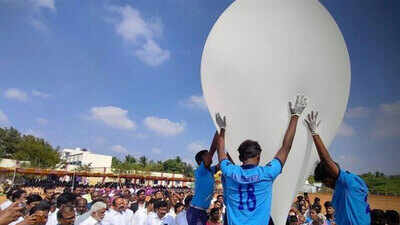
Fifty-five students from 11 government middle schools in Tamil Nadu’s Coimbatore district took part in an atmospheric research mission that sent a scientific payload to an altitude of around 35 km above Earth. The approximately 2 kg instrument travelled aboard a helium-filled high-altitude balloon launched on October 30, 2026, as part of Project Uyarvu.The initiative gave students from Classes 6 to 8 practical exposure to atmospheric science, scientific instrumentation and environmental research. Instead of limiting their learning to classroom experiments, they participated in a project involving the launch and recovery of an instrument designed to collect atmospheric data.
What did the students send into the stratosphere?
The payload carried sensors to record temperature, atmospheric pressure, relative humidity and altitude. It also included a passive particle trap to collect airborne particulate matter, allowing the project team to study atmospheric aerosols.The balloon was launched from Thudiyalur Corporation Middle School after permission was obtained from the Airports Authority of India. It reportedly remained airborne for nearly three hours, reaching approximately 35 km before descending around 80 km from the launch site. A recovery team retrieved the payload.During its ascent, the instrument experienced temperatures as low as minus 60 degrees Celsius and atmospheric density of about one per cent of that at ground level, according to local reports.The project received technical guidance from Coimbatore-based CSTERC Techno Science LLP, an organisation working in space science and technology.
330 more students to analyse the research data
The launch is only one part of Project Uyarvu. Around 330 students are expected to take part in the next phase, analysing the data collected during the flight.They will examine the readings, study local environmental concerns and prepare research reports for district authorities and environmental experts. This phase is intended to connect the measurements gathered at different altitudes with questions about the environment around their communities.The exercise also introduces students to the stages of scientific research, from developing an instrument and collecting measurements to interpreting data and presenting findings.
A school experiment sparks interest in space science
The experience has already influenced how some participants view science and their future aspirations. K Thiyash, a Class 8 student at Thudiyalur Corporation Middle School, said watching the balloon lift off and learning that the payload would travel higher than commercial aircraft had made a strong impression on him. He said the project had encouraged him to pursue a career as a space scientist.A coordinating teacher at the school, Chitra, said students had shown keen interest in experimenting and exploring during the initiative. She added that practical exposure could help develop their confidence and critical-thinking skills.By involving government-school students in an actual atmospheric research exercise, Project Uyarvu has extended science learning beyond textbook concepts. The planned data-analysis phase will give hundreds more students an opportunity to work with measurements collected during the high-altitude flight.