

The government’s decision to increase the provident fund wage ceiling from Rs 15,000 to Rs 25,000 is one of the most significant social security reforms in recent years. The move is expected to expand provident fund, pension and insurance coverage to additional employees, while also enhancing retirement benefits for many existing members.For employees, however, the immediate reaction may be simple: What does this mean for me?The answer depends on an employee’s wage structure, provident fund membership status and pension coverage. While some employees may see higher PF deductions, others may gain access to social security benefits for the first time. The change could also have a meaningful impact on long-term retirement savings and pension entitlement.Here are some key questions relevant for employees:
Am I mandatorily required to be covered under PF?
An employee whose statutory “wages” are up to Rs 25,000 will now fall within mandatory PF coverage. The biggest impact is likely to be on employees earning statutory wages above Rs 15,000 but up to Rs 25,000 who were previously outside mandatory coverage.It is important to note that the reference is to “wages” as defined under the Code on Social Security, 2020.
How much could my PF contribution increase? Will my take-home salary reduce?
For some employees, yes.The change is likely to affect two categories of employees:
- Employees whose monthly wages are Rs 25,000 or more, but whose
PF contributions were restricted to the earlier statutory ceiling of Rs 15,000; and
- Employees whose monthly wages are above Rs 15,000 and up to Rs 25,000, including those who are newly brought within mandatory PF coverage.
For these employees, PF contributions will now be calculated on the revised ceiling of Rs 25,000 or on their actual ‘wages’, where these are below the revised ceiling.Employees already contributing on wages above Rs 25,000 will not see an increase in their total monthly PF contributions. However, the internal allocation of the employer’s contribution between provident fund and pension may still change.The impact will therefore depend on the employee’s wage level and the contribution basis followed before the change.Earlier, when PF contributions were restricted to the Rs 15,000 ceiling, the maximum monthly contribution was Rs 1,800. Following the increase in the ceiling to Rs 25,000, the monthly contribution can rise to Rs 3,000. Employees may therefore see an additional PF deduction of up to Rs 1,200 per month, reducing their monthly take-home salary.The impact may be more significant for an employee who was previously outside PF coverage but is now mandatorily covered. Since there was no corresponding deduction earlier, the employee’s take-home pay could reduce by the full amount of the new contribution.The reduction in take-home pay does not mean that the amount is lost or paid as a tax. It is deposited into the employee’s PF account and becomes part of the employee’s retirement savings. Employees will therefore have lower disposable income today, but a larger amount set aside for their long-term financial security.
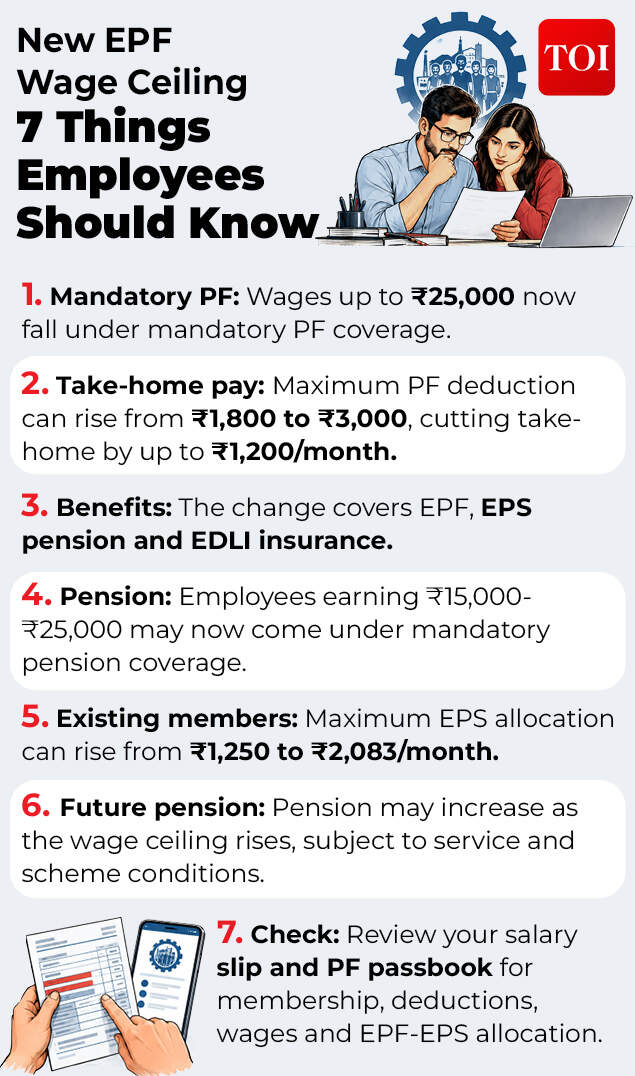
New PF wage ceiling: 7 things to know
Does the change affect only PF or any other benefits also?
No. The revised ceiling affects three important social security benefits:
- Employees’ Provident Fund, which helps employees build retirement savings
Employees’ Pension Scheme , which provides a monthly pension to eligible members- Employees’ Deposit-Linked Insurance Scheme, which provides employment-linked insurance protection
The reform is therefore broader than a simple increase in PF deductions. It can affect an employee’s retirement savings, pension coverage / entitlement and insurance protection.
Am I now mandatorily required to become a pension member?
The increase in the ceiling means that employees earning statutory wages above Rs 15,000 but up to Rs 25,000 will now come within pension coverage, if such employees were not members under the Pension Scheme earlier.
If I am an existing member of Pension Scheme, will there be any impact on my pension contributions?
Yes.The employer’s contribution of 12% is divided between Provident Fund and Pension Scheme. The amount allocated to Pension Scheme is 8.33% of ‘wages’, subject to the applicable wage ceiling. The balance of the employer’s contribution is allocated to the employee’s Provident Fund account.With the ceiling increasing from Rs 15,000 to Rs 25,000, the maximum monthly amount allocated to Pension Scheme can increase from Rs 1,250 to Rs 2,083. As a result, a larger portion of the employer’s contribution may be directed towards pension and a correspondingly smaller portion towards the employee’s Provident Fund account.This change can also affect existing pension members whose wages exceed Rs 25,000.
Could my future pension entitlement increase?
Potentially, yes.Monthly pension under Pension Scheme is linked to pensionable ‘wages’ (subject to the ceiling) and the employee’s pensionable service. Since the pensionable wage ceiling has increased from Rs 15,000 to Rs 25,000, eligible employees may receive a higher monthly pension upon retirement as compared with the amount calculated using the earlier ceiling.However, the increase will not be identical for every employee. The actual pension will depend on factors such as average pensionable wages, years of pensionable service, the period for which contributions are made at the revised ceiling and the applicable scheme conditions.
What should I check on my salary slip / provident fund passbook to understand the impact?
Employees may check the following aspects basis their salary slips / PF passbooks to understand the impact of the change:
- PF and Pension membership status
- Employee’s PF deduction;
- Employer’s total contribution;
- Wages used for calculating contributions;
- Allocation between EPF and EPS, where applicable
Looking beyond the monthly deduction
The immediate focus for many employees will understandably be the potential reduction in take-home pay. However, the revised ceiling should also be viewed from a longer-term perspective.For employees newly brought within mandatory coverage, the change provides access to formal retirement savings, pension protection and employment-linked insurance coverage. For existing members, it may result in higher contributions, a different allocation between PF and pension, and a potentially higher pension benefit over time.
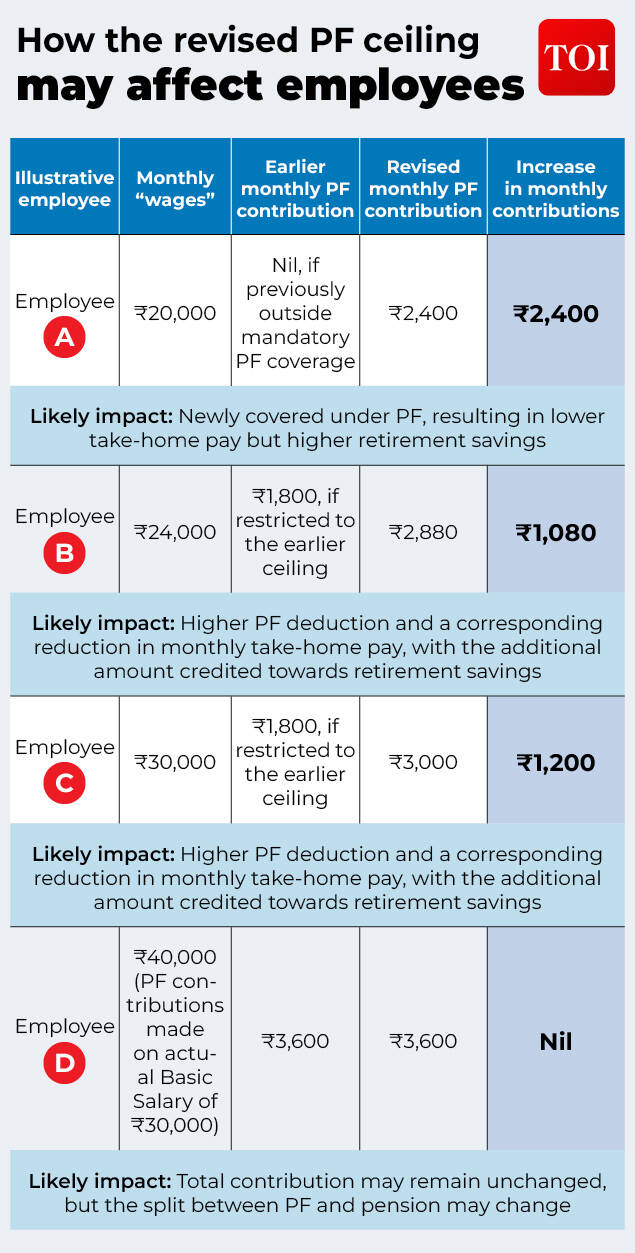
How the revised PF ceiling may affect employees
Employees should therefore understand not only how much is being deducted from their salary, but also where the contribution is being deposited and how it supports their long-term financial security. PF savings can also provide financial support during important life events. Employees may make partial withdrawals for specified purposes, such as marriage, purchasing a house or medical treatment, through a simplified claims process on the EPFO online portal.The reform may therefore be viewed not merely as a higher monthly deduction, but as an investment in greater financial security for employees and their families.(The author, Puneet Gupta is Partner, People Advisory Services Tax at EY India. Viraj Lele, Director, EY India also contributed to the article)